
In the fast-paced world of Amazon selling, optimizing your product listings is crucial to driving sales and staying ahead of the competition. One of the most essential elements of this process is identifying high-value keywords that resonate with your target audience and help your product rank on page one. This article dives deep into the keyword research process, leveraging the powerful Data Dive tool, and offers actionable insights to help you streamline your listing optimization strategy. Whether you’re an Amazon brand owner, marketer, or part of an operational team, this guide will empower you to use data-driven approaches to optimize your listings like a pro.
Why Keywords Matter in Amazon Listings

Keywords are the cornerstone of effective Amazon SEO. They determine how your products are discovered by shoppers and where they rank in search results. Choosing the right keywords not only drives visibility but also ensures you’re reaching the most relevant audience for your products. However, with the sheer volume of data available, the process can be overwhelming. This is where tools like Data Dive shine by simplifying the keyword discovery process and providing a roadmap for success.
sbb-itb-ed4fa17
Step-by-Step Guide to Finding High-Value Keywords Using Data Dive
1. Understand the Basics of the Process
Keyword research begins with understanding your product and its target customers. As demonstrated in the example of "bully sticks" (a natural dog treat), it’s critical to identify:
- The purpose of your product
- The needs it fulfills for customers
- Attributes that differentiate it from competitors
This foundation guides your keyword strategy, ensuring you focus on terms that matter most to your audience.
2. Build Your Product "Tray"
Data Dive simplifies keyword research by allowing you to create a "tray" of similar or competing products. This involves:
- Searching for your product type (e.g., "bully sticks") on Amazon
- Selecting relevant competitor products from the results
- Adding these products to your tray using the Data Dive browser extension
The tray serves as the starting point for analyzing competitors and extracting actionable data. Depending on your product’s category, you can choose between two approaches:
- Niche Dive: Ideal for established categories with clear competitors.
- Manual Tray Creation: Suitable for unique products, bundles, or those spanning multiple categories.
If your product doesn’t fit neatly into one category, combining competitors manually ensures you capture all relevant data.
3. Assess Competitor Insights
Once your tray is populated, Data Dive analyzes the included products to identify top competitors, their strengths, and weaknesses. This includes:
- Assessing "strong" competitors for inspiration and insights
- Identifying "weak" competitors as potential opportunities to stand out
- Reviewing search volume, relevance, and competition for specific keywords
By focusing on competitors’ keyword usage, you can pinpoint gaps and opportunities to position your product more effectively.
4. Leverage the Master Keyword List
The Master Keyword List is the heart of Data Dive’s functionality. It provides a detailed, color-coded breakdown of:
- Keywords ranked by relevance and search volume
- Competitor performance on these keywords
- Opportunities to differentiate your product through strategic keyword usage
Prioritize keywords that are:
- Highly relevant to your product
- Frequently searched by your target audience
- Less saturated with competition
5. Don’t Overlook Outliers and Residue
In addition to the Master Keyword List, Data Dive offers insights into "outliers" and "residual" keywords:
- Outliers: These may seem less relevant but can uncover hidden opportunities, especially if they align with niche customer needs. For example, keywords like "dog chews rawhide free" or "long-lasting dog chews" may resonate with specific buyer preferences.
- Residue: While least relevant overall, residue keywords can sometimes include untapped gems. For instance, terms like "collagen sticks" might be worth exploring if they describe a secondary benefit your product offers.
Taking the time to evaluate these lists ensures no valuable keyword is left behind.
6. Watch Out for Prohibited and Branded Keywords
Not all keywords are safe to use. Be vigilant about:
- Avoiding branded keywords from competitors (e.g., "Pupford" or "Natural Farm")
- Steering clear of prohibited terms that violate Amazon’s policies Reviewing your keyword list thoroughly safeguards your listings from potential penalties or delistings.
7. Implement Keywords Strategically
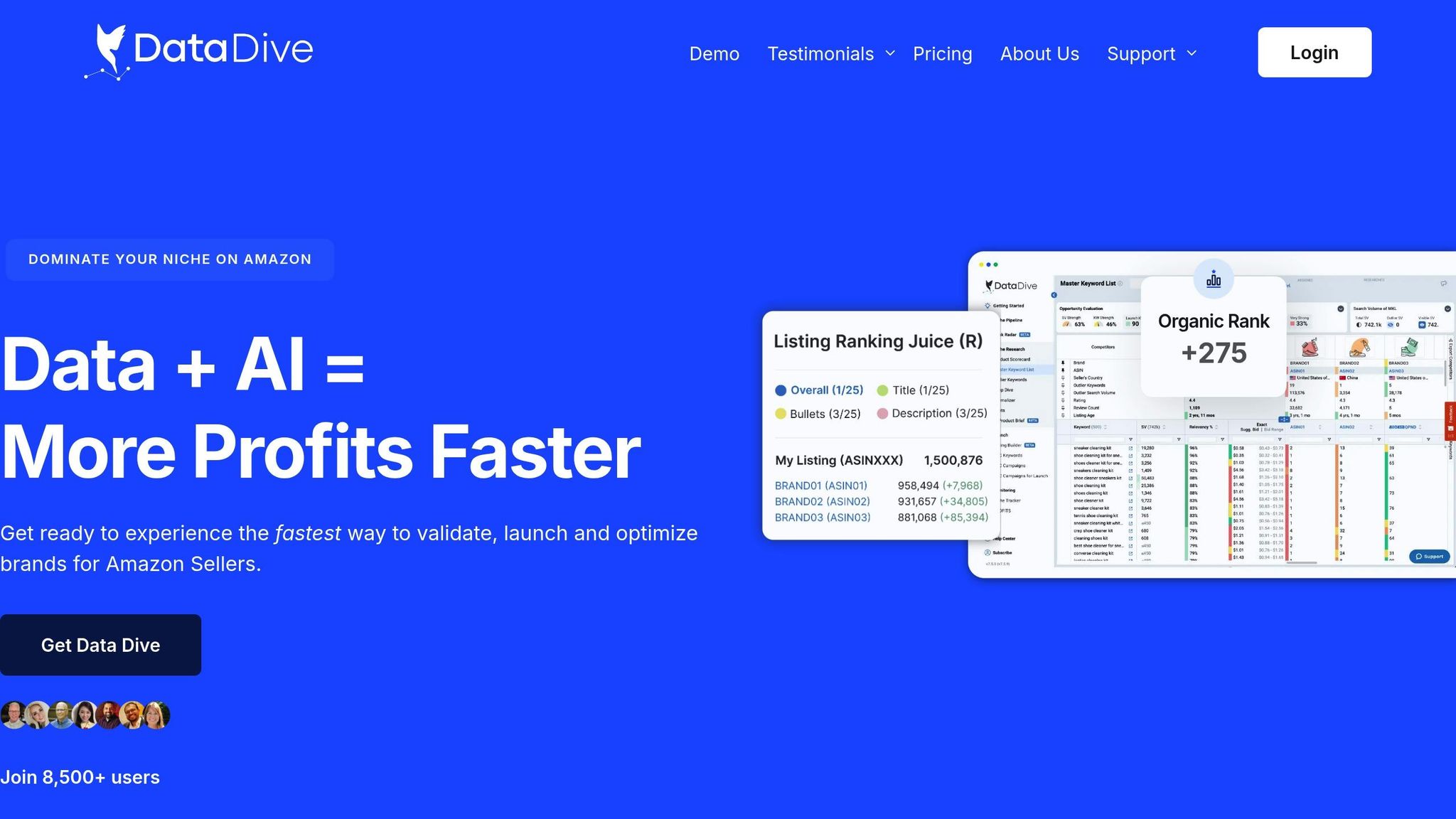
Once you’ve finalized your keyword list, the next step is implementation. Data Dive’s Listing Builder tool makes this process efficient by:
- Tracking keyword usage across titles, bullet points, and descriptions
- Ensuring SEO-friendly formatting
- Avoiding repetitive keyword usage Using the tool, you can evaluate the "ranking juice" of your listing compared to competitors and refine it for maximum visibility.
8. Benchmark Listings with Battle of the Listings
Data Dive’s "Battle of the Listings" feature allows you to directly compare your listing against competitors. You can assess:
- Title optimization and ranking juice
- Keyword coverage in bullet points and descriptions
- Overall listing performance This granular insight ensures your listing is as competitive as possible.
Common Gaps to Address in Keyword Research
While tools like Data Dive are invaluable, they’re not infallible. To create a truly comprehensive strategy:
- Cross-reference with other tools to validate Data Dive’s recommendations
- Conduct customer research to identify language, preferences, and frequently asked questions
- Continuously monitor trends to adapt to changing customer needs
This multi-pronged approach ensures you’re not missing any high-value keywords that can give your business an edge.
Key Takeaways
- Keyword research is essential to driving Amazon sales and boosting product visibility.
- Understand your target audience to ensure your chosen keywords align with their needs and preferences.
- Use Data Dive to streamline keyword discovery, leveraging tools like the Master Keyword List, Outliers, and Residue for comprehensive insights.
- Be strategic with keyword implementation, ensuring proper usage across titles, bullet points, and descriptions.
- Avoid prohibited or branded keywords to maintain compliance with Amazon’s guidelines.
- Benchmark against competitors using tools like Battle of the Listings to refine your strategy.
- Don’t rely solely on one tool. Cross-reference with other data sources and stay attuned to new trends.
Final Thoughts
Optimizing your Amazon listings with high-value keywords is a foundational step to achieving eCommerce success. By combining the power of tools like Data Dive with careful manual analysis, you can uncover actionable insights that set your brand apart. Remember, keyword research is an ongoing process – it’s not just about finding the right keywords today but staying ahead of the competition tomorrow. Invest the time and effort, and the results will speak for themselves. Happy optimizing!
Source: "The Keyword Method I Use to Help Brands Rank #1 on Amazon" – Marketing by Emma, YouTube, Jun 10, 2025 – https://www.youtube.com/watch?v=aD6ZPk2R0kQ